
Intensive training days
CORPORATE TRAINING PROFILE
Positive Thinking SkillsBehn Meyer Agricare Vietnam Company
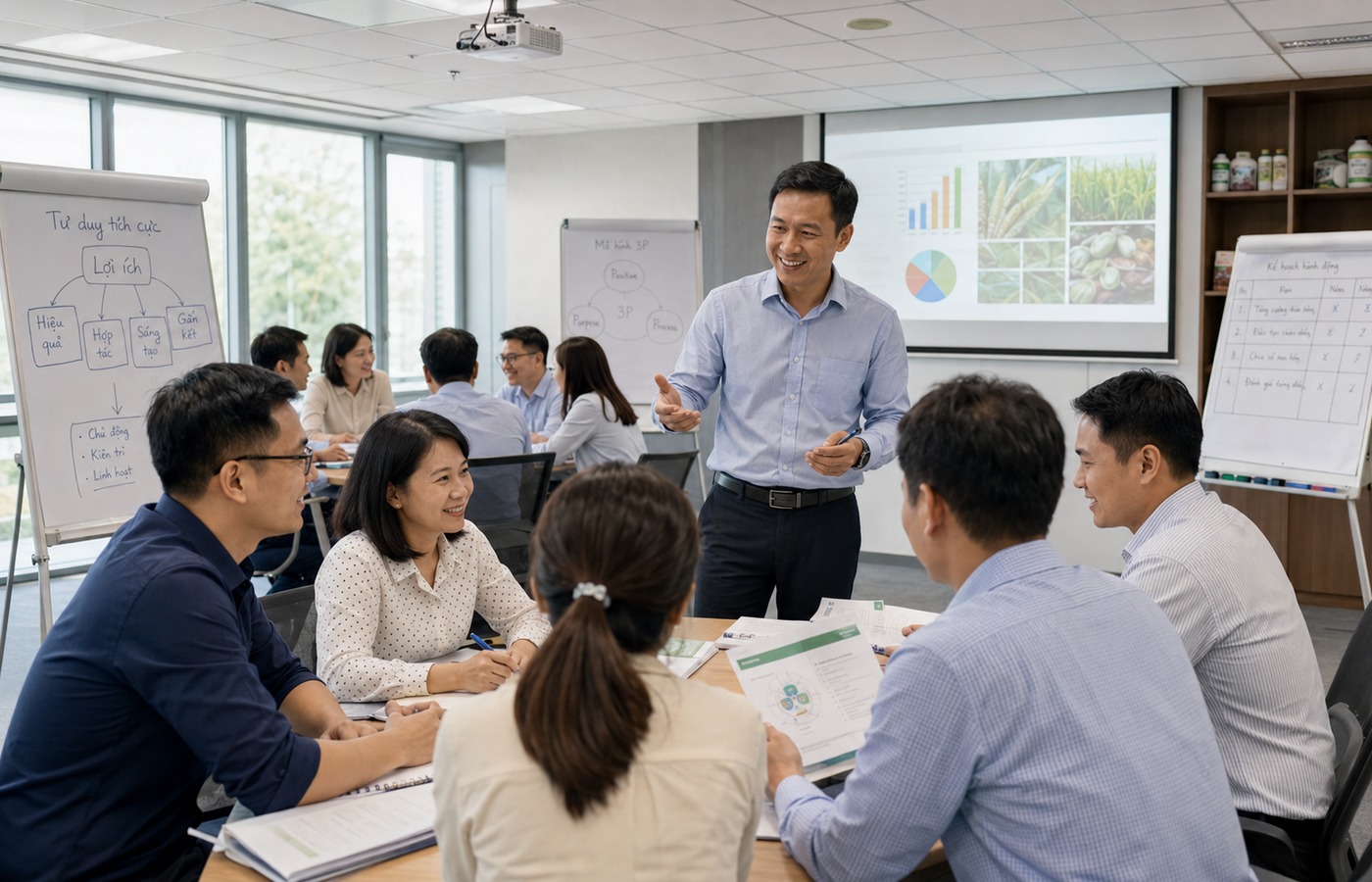
This profile documents the in-house “Positive Thinking Skills” program delivered for Behn Meyer Agricare Vietnam Company. It summarizes the business context, capability objectives, program modules, practice tools, survey results, participant feedback and course photos.
Core modules
Overall satisfaction
Participant feedback
1. Training Profile Overview
Behn Meyer Agricare Vietnam Company
Behn Meyer Agricare Vietnam Company operates in specialty chemicals and agricultural solutions. This profile presents the organization as the client for the positive thinking Skills program and highlights the operating context, target audience and capability-development needs behind the engagement.
The “Positive Thinking Skills” program was delivered for Employees in production and business environments who want to develop positive thinking at work. The content was connected to the work context of Behn Meyer Agricare Vietnam Company, helping participants practice relevant methods and apply learning after training.
2. Training Solution Delivered
Program Purpose
Strengthen practical capability in positive thinking Skills and help participants transfer relevant knowledge, tools and behaviors into daily work.
Delivery Approach
The program combined concise lectures, guided discussion, case exercises and practice tools across the core modules.
Capability Focus
The focus was on understanding core concepts, practicing methods and tools, and building suitable application plans for real work situations.
Target Outcomes
The expected outcome was to convert knowledge into practical actions while improving coordination, execution quality and confidence after training.
3. Training Context, Capability Needs and Objectives
Implementation Context
The business context created a need to strengthen positive thinking Skills, improve consistency of execution and connect training content with practical work requirements.
Capability Needs
Participants needed a shared language, practical tools and structured methods to apply positive thinking Skills more effectively in their roles.
Training Objectives
After training, participants were expected to apply relevant techniques, coordinate more effectively and turn the program content into concrete workplace actions.
4. Program Content and Practice Tools
SessionModule
Learning Objectives
- Key Content
- Practice Tools
01Attitude at Work and in Life
Understand and apply the key concepts, tools and workplace practices in attitude at work and in life.
- Attitude at Work and in Life: application exercise 1Case exercise
- Attitude at Work and in Life: application exercise 2Case exercise
- Attitude at Work and in Life: application exercise 3Case exercise
- Attitude at Work and in Life: application exercise 4Case exercise
- Attitude at Work and in Life: application exercise 5Case exercise
02Building a Positive Mindset
Understand and apply the key concepts, tools and workplace practices in building a positive mindset.
- Building a Positive Mindset: application exercise 1Case exercise
- Building a Positive Mindset: application exercise 2Case exercise
- Building a Positive Mindset: application exercise 3Case exercise
- Building a Positive Mindset: application exercise 4Case exercise
- Building a Positive Mindset: application exercise 5Case exercise
03Applying Positive Thinking
Understand and apply the key concepts, tools and workplace practices in applying positive thinking.
- Applying Positive Thinking: application exercise 1Case exercise
- Applying Positive Thinking: application exercise 2Case exercise
- Applying Positive Thinking: application exercise 3Case exercise
- Applying Positive Thinking: application exercise 4Case exercise
- Applying Positive Thinking: application exercise 5Case exercise
04Practicing Daily Habit Change
Understand and apply the key concepts, tools and workplace practices in practicing daily habit change.
5. Results and Application Value
Capabilities Strengthened
Participants reinforced knowledge, behaviors and tools related to positive thinking Skills.
Application Capability
Participants practiced how to apply the program content through structured exercises and workplace-oriented examples.
Coordination and Execution
The program supported clearer coordination, shared understanding and more consistent execution among participants.
Value for Work
The learning outcomes provide practical value for daily work, team collaboration and continuous improvement after training.
6. Course Survey Results
Overall Satisfaction
Practical Applicability
Content Quality
Training Methodology
Post-Training Applicability
Commitment to Post-Training Application
7. Participant Feedback
“
The course provided practical methods that I can apply directly in my work.

Nguyen Van HungParticipantBehn Meyer Agricare Vietnam Company
“
The examples and exercises made the positive thinking Skills content easier to understand.

Tran Thi MaiParticipantBehn Meyer Agricare Vietnam Company
“
The instructor connected the lessons with real situations in our organization.

Le Quoc BaoParticipantBehn Meyer Agricare Vietnam Company
“
The practice activities helped me see how to improve my daily work approach.

Pham Thu TrangParticipantBehn Meyer Agricare Vietnam Company
“
The program was useful, practical and easy to share with my team.

Do Minh TuanParticipantBehn Meyer Agricare Vietnam Company
“
I gained clearer tools and more confidence to apply the learning after class.

Bui Thi Lan AnhParticipantBehn Meyer Agricare Vietnam Company
DELIVERY EVIDENCE
8. Course Delivery Photos
.jpg) | .jpg) | .jpg) |
.jpg) |