
Intensive training duration
CORPORATE TRAINING PROFILE
Stress Management SkillsHo Chi Minh City Union of Trading Cooperatives (Saigon Co.op)
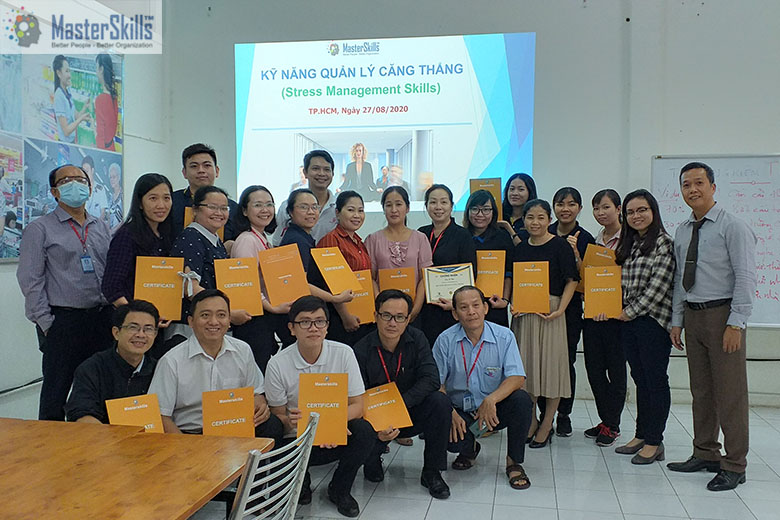
This profile documents the in-house “Stress Management Skills” training program delivered by Masterskills for Ho Chi Minh City Union of Trading Cooperatives (Saigon Co.op). It summarizes the context, objectives, practical modules, survey results, participant feedback and class photos.

Program modules
Overall satisfaction
Participant feedback
1. Training Profile Overview
Ho Chi Minh City Union of Trading Cooperatives (Saigon Co.op)
Ho Chi Minh City Union of Trading Cooperatives (Saigon Co.op) operates in retail and consumer-goods distribution. This training profile presents its business context and the capability-development needs addressed through the in-house program.
The organization places strong emphasis on developing its people. The “Stress Management Skills” program was positioned as a practical intervention to improve work quality, coordination and professional capability.
2. Training Solution Delivered
Program Purpose
The program was designed to strengthen practical stress management skills capability for participants and connect learning with real work situations at Ho Chi Minh City Union of Trading Cooperatives (Saigon Co.op).
Delivery Approach
The training combined concise instruction, facilitated discussion, case exercises, practice tools and feedback so participants could apply the methods immediately.
Capability Focus
The capability focus included awareness, structured methods, practical tools, collaboration and implementation discipline related to stress management skills.
Target Outcomes
Expected outcomes included stronger awareness, better use of tools, improved coordination and clear action plans after training.
3. Training Context, Capability Needs and Objectives
Implementation Context
The operating context showed a need to strengthen stress management skills in daily work, especially in situations requiring coordination, analysis, decision quality and consistent execution.
Capability Needs
Participants needed practical methods, shared language and structured tools to apply stress management skills more effectively in their roles.
Training Objectives
After the program, participants were expected to apply stress management skills techniques, practice with real cases and convert learning into workplace action.
4. Program Content and Practice Tools
SessionModule
Module objective
- Key content
- Practice tools
01identification Stress - Ke thu tham lang
Core concepts and practice focus for applying stress management skills in workplace situations.
- Practice and apply “identification Stress - Ke thu tham lang” through work-related exercises. Case exercises
- Practice and apply “identification Stress - Ke thu tham lang” through work-related exercises. Case exercises
- Practice and apply “identification Stress - Ke thu tham lang” through work-related exercises. Case exercises
02Stress Management Skills Practice Module 2
method hit tho sau and the exercise gian co at for.
- Practice and apply “Stress Management Skills Practice Module 2” through work-related exercises. Case exercises
- Practice and apply “Stress Management Skills Practice Module 2” through work-related exercises. Case exercises
- Practice and apply “Stress Management Skills Practice Module 2” through work-related exercises. Case exercises
03Stress Management Skills Practice Module 3
Core concepts and practice focus for applying stress management skills in workplace situations.
- Practice and apply “Stress Management Skills Practice Module 3” through work-related exercises. Case exercises
- Practice and apply “Stress Management Skills Practice Module 3” through work-related exercises. Case exercises
- Practice and apply “Stress Management Skills Practice Module 3” through work-related exercises. Case exercises
04Stress Management Skills Practice Module 4
Core concepts and practice focus for applying stress management skills in workplace situations.
- Practice and apply “Stress Management Skills Practice Module 4” through work-related exercises. Case exercises
- Practice and apply “Stress Management Skills Practice Module 4” through work-related exercises. Case exercises
- Practice and apply “Stress Management Skills Practice Module 4” through work-related exercises. Action plan
5. Results and Application Value
Capability Developed
Participants strengthened practical capability in stress management skills and understood how to use the relevant tools in real work situations.
Workplace Application
The learning can be applied to improve work quality, coordination, decision making and problem handling in daily operations.
Implementation Coordination
The program supported clearer collaboration among participants, teams and related departments during implementation.
Post-Training Value
Post-training value comes from practical application, shared working methods and a clearer action plan for continued improvement.
6. Course Survey Results
Overall Satisfaction
Practical Applicability
Content Quality
Training Methodology
Post-Training Applicability
Commitment to Post-Training Application
7. Participant Feedback
“
The course provided practical tools that I can apply directly at work.

Training ModuleParticipantHo Chi Minh City Union of Trading Cooperatives (Saigon Co.op)
“
The examples and exercises helped me understand the topic more clearly.

Training ModuleParticipantHo Chi Minh City Union of Trading Cooperatives (Saigon Co.op)
“
The facilitator connected the content with realistic business situations.

Le Van PhuocParticipantHo Chi Minh City Union of Trading Cooperatives (Saigon Co.op)
“
The practice activities made the learning easy to remember and apply.

Pham Hoai ThuParticipantHo Chi Minh City Union of Trading Cooperatives (Saigon Co.op)
“
The program helped me improve my working methods and collaboration.

Do Xuan BachParticipantHo Chi Minh City Union of Trading Cooperatives (Saigon Co.op)
“
The training was practical, focused and relevant to my role.

Vu Diem MyParticipantHo Chi Minh City Union of Trading Cooperatives (Saigon Co.op)
DELIVERY EVIDENCE
8. Program Delivery Photos
.jpg) | .jpg) | .jpg) |
 .jpg) | .jpg) |
 .jpg) | -780x439.jpg) |
 |